

How To Choose The Right Drone Frames In 2026
Choosing the right FPV drone frame in 2026 is less about appearance than how the geometry, stiffness, mounting pattern, and camera clearance support the way you fly. A frame changes the quad’s weight, vibration behavior, crash durability, power-to-weight ratio, camera view, and even how confidently it holds a line at speed.
Choose a True-X or compact H-frame for predictable racing and high-speed handling, a stretched-X frame for freestyle and stronger forward-flight authority, or a deadcat, squashed-X, or hybrid frame when HD camera clearance matters for cinematic and long-range flying. Then confirm that the frame fits your motor bolt pattern, flight-controller stack, battery layout, FPV camera spacing, and video-transmitter cooling requirements. The best frame is the lightest design that provides enough stiffness, protection, and mounting flexibility for your power system and flying environment.
Quick Answer
Table of Contents
- Quick Answer
- Our Top Picks
- Match Frame Geometry to Your Flying Style
- Balance Weight, Stiffness, and Crash Durability
- Check Motor, Stack, Camera, and Battery Compatibility
- Understand Carbon Fiber and 3D-Printed Frame Design
- Build Around Vibration Control, Cooling, and Serviceability
- Frequently Asked Questions
- Sources & References
Our Top Picks
Affiliate disclosure: if you buy through these links, we may earn a commission at no extra cost to you.


Match Frame Geometry to Your Flying Style
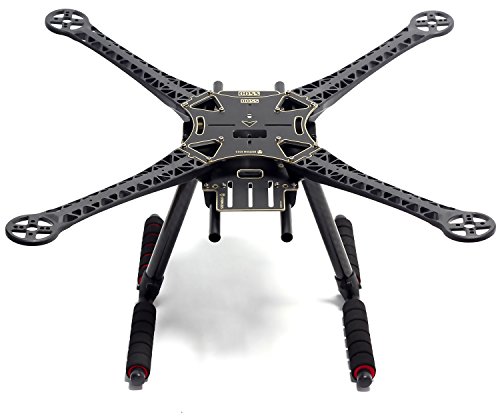
Frame geometry determines how the quad distributes its motors around the center of gravity. That changes the feel of pitch, roll, and yaw inputs, as well as how the aircraft tracks during acceleration, reversals, dives, and recovery from propwash. Select the geometry for the flight task first; a visually unusual frame is not automatically a better-performing frame.
True-X frames place all four arms at equal length and 90-degree intervals. This gives the quad a balanced, predictable flight feel, which is useful for freestyle maneuvers and general-purpose builds. Because the motor layout is symmetrical, tuning and weight distribution are comparatively straightforward, provided the battery, camera, and electronics are mounted near the intended center of gravity.
Stretched-X frames use longer front arms and a wider stance. This layout can improve authority during fast forward flight and may help with propwash handling, making it a strong match for freestyle pilots who carry speed through dives, gaps, and long lines. The trade-off is that the altered motor spacing can reduce yaw authority compared with a more compact, symmetrical layout, so the flight controller and motor setup need to be considered as a complete system.
Deadcat and squashed-X frames splay the front arms outward to keep propellers out of an HD camera’s field of view. That makes them attractive for cinematic and long-range builds where clean footage is more important than the most symmetrical freestyle response. H-frame designs use parallel arms and a central pod, creating a low-profile layout that can suit racing, although the additional structure generally adds weight and reduces agility.
Balance Weight, Stiffness, and Crash Durability
A frame is part of the aircraft’s power-to-weight calculation. Every extra gram requires additional thrust during hover and acceleration, leaving less performance margin for recovering from a dive, carrying a large battery, or maintaining speed in wind. However, removing material indiscriminately can create flex, vibration, cracked arms, or loose hardware that causes more problems than the weight saving is worth.
Arm stiffness is especially important because the arms carry motor loads and transmit high-frequency vibration into the flight controller and camera. The UAVMODEL FPV Drone Frame Selection Guide: Geometry, Materials, and Arm Design 2026 describes I-beam and box-beam arm cross sections as 3–4 times stiffer per gram than solid rectangular arms. The useful lesson is not to judge a frame only by plate thickness: the shape and distribution of material can matter as much as the amount of material.
Stiffness also affects video quality and flight-controller filtering. A flexible arm can allow motor-induced vibration to reach the gyro, while a poorly supported camera can turn the same vibration into visible jello or rolling-shutter artifacts. A frame that is slightly heavier but substantially stiffer can produce a cleaner, more consistent aircraft than an ultralight frame that requires aggressive filtering or repeated repairs.
Consider the expected crash environment as part of the design brief. Freestyle frames need protected electronics and arms that can tolerate repeated impacts, while racing frames may prioritize low mass and a compact frontal profile. Long-range frames need room for batteries, GPS hardware, antennas, and an HD camera without placing fragile components on exposed edges.
Check Motor, Stack, Camera, and Battery Compatibility
Before choosing a frame, map its mounting points against every major component in the build. The motor bolt pattern must match the motors or motor mounts, and the flight-controller mounting holes must fit the stack you intend to use. Common flight-controller stack patterns include 20×20, 25.5×25.5, and 30.5×30.5 mm, but a frame may support only one pattern or require adapters.
The UAVMODEL 3D Printed FPV Drone Frame Design Guide 2026: Materials, Structural ... recommends 16×16, 16×19, or 19×19 mm motor bolt patterns and 2 mm bolt holes for 3D-printed frame motor mounts. These dimensions are useful reference points, but the actual motor, printed mount, bolt length, and locking method still need to be checked together. Bolts that are too long can contact motor windings or prevent the motor from seating correctly.
Camera spacing is another frequent source of incompatibility. The UAVMODEL guide identifies approximately 19 or 20 mm as common camera spacing, with adjustable camera tilt of roughly 15–45 degrees. Adjustable tilt is valuable because racing, freestyle, and long-range flying use different forward-speed and horizon requirements. Make sure the frame’s side plates or camera cage allow the desired tilt without forcing the lens against a support.
Also inspect the available room for the battery, receiver, GPS, capacitor, antenna mounts, and video transmitter. A powerful FPV transmitter may need airflow and physical separation from the receiver and GPS. A long-range build may need a larger battery and a secure strap path, while a racing build benefits from a compact battery position that keeps the center of gravity close to the flight-controller gyro.
Understand Carbon Fiber and 3D-Printed Frame Design
Carbon-fiber frames remain popular because they combine low mass with high stiffness, but carbon terminology can be misleading. The “3K” label describes the number of filaments per tow in the weave; it does not, by itself, establish the frame’s overall strength or quality. Layup, plate thickness, fiber orientation, resin quality, arm shape, and machining accuracy all affect how the finished frame behaves.
The UAVMODEL FPV Drone Frame Selection Guide: Geometry, Materials, and Arm Design 2026 lists T700 carbon fiber at approximately 240 GPa in tensile modulus and T800 at approximately 294 GPa. Those figures can help explain why carbon grade appears in frame specifications, but they should not be treated as a complete prediction of flight performance. A poorly designed layup can underperform a well-designed frame made from a different material.
3D-printed frames can be practical for prototypes, lightweight experimental aircraft, and custom layouts, but their design must account for print direction, layer adhesion, heat, and stress concentration. The UAVMODEL 3D Printed FPV Drone Frame Design Guide 2026: Materials, Structural ... recommends at least 2 mm fillets at arm-to-body junctions to reduce stress concentrations and cracking. Rounded transitions are particularly important where narrow arms meet a central body.
For printed designs, reinforced arm geometry, vibration-isolated stack mounts, and TPU camera supports are more useful than simply increasing wall count everywhere. The same guide lists PA-CF nylon at approximately 110 MPa tensile strength and a 150°C heat-deflection temperature, while PA-GF nylon is listed at approximately 90 MPa tensile strength and a 140°C heat-deflection temperature. These material figures are reference values, not guarantees for a specific print, because nozzle temperature, layer orientation, infill, cooling, and post-processing affect the finished part.
Build Around Vibration Control, Cooling, and Serviceability
Frame selection should leave enough physical separation for clean wiring and reliable maintenance. A tight frame can look efficient but become frustrating when the ESC, flight controller, receiver, capacitor, or video transmitter cannot be removed without dismantling the entire aircraft. Racing builds often accept compact packaging for lower mass, while freestyle and long-range builds benefit from extra room for protection and field repairs.
The frame should also support the thermal needs of the electronics. ESCs and FPV transmitters generate heat, particularly when the aircraft is powered on the ground or operated in hot conditions with limited airflow. Avoid blocking the video transmitter’s ventilation with a battery pad, printed cover, or tightly wrapped antenna cable. Keep high-current battery wiring short and protected, and provide a secure location for the capacitor where it cannot strike the propellers or rub against carbon edges.
Camera and stack isolation must be used carefully. Soft-mounted components can reduce unwanted vibration, but excessive movement can introduce its own problems, including oscillation, blurry footage, or unreliable gyro data. The goal is controlled isolation with firm hardware retention, not a camera or flight controller that can move freely inside the frame.
Finally, plan for the crash that will eventually happen. Replaceable arms, accessible motor screws, protected camera sides, sacrificial TPU parts, and clear antenna routing can reduce downtime. For a long-range quad, serviceability also includes being able to inspect GPS mounts, receiver antennas, battery straps, and video-transmitter connections without disturbing the rest of the aircraft.
Frequently Asked Questions
Is a True-X frame better than a stretched-X frame?
Neither is universally better. True-X geometry provides a balanced, predictable layout that suits freestyle and general-purpose flying, while stretched-X geometry can offer stronger forward-flight authority and propwash behavior at the possible expense of yaw authority.
Why do cinematic FPV drones use deadcat frames?
Deadcat and squashed-X frames move the front arms outward so the propellers are less likely to appear in the HD camera’s field of view. This is useful when clean footage matters more than the most symmetrical racing or freestyle response.
Does a 3K carbon-fiber frame mean it is stronger?
No. 3K describes the filament count in the weave, not the complete strength or quality of the frame. Evaluate the carbon grade, layup, plate construction, arm design, and machining together.
What flight-controller mounting pattern should a frame support?
Common patterns include 20×20, 25.5×25.5, and 30.5×30.5 mm. Match the frame to the flight-controller and ESC stack you plan to use, and check whether adapters or unusual hardware are required.
Are 3D-printed FPV frames durable enough for regular flying?
They can be suitable when the material, print orientation, arm reinforcement, and stress-relief geometry are appropriate. Printed designs should use rounded arm junctions, strong motor mounts, controlled vibration isolation, and adequate protection around high-load areas.
How much camera tilt should an FPV frame allow?
Approximately 15–45 degrees is identified as a common adjustable range in the UAVMODEL guide. Lower tilt can suit slower cinematic flying, while higher tilt can help pilots maintain a clear forward view during fast racing or freestyle flight.
The right FPV drone frame is the one that matches your flight geometry, electronics, camera view, battery plan, and crash environment without adding unnecessary mass. Start with True-X, stretched-X, deadcat, squashed-X, or H-frame geometry according to the mission, then verify motor and stack patterns, camera clearance, stiffness, cooling, and service access. Before ordering or cutting parts, make a full-scale layout of the build and confirm that the finished aircraft will have the power-to-weight ratio, vibration control, and component protection your flying style demands.


